
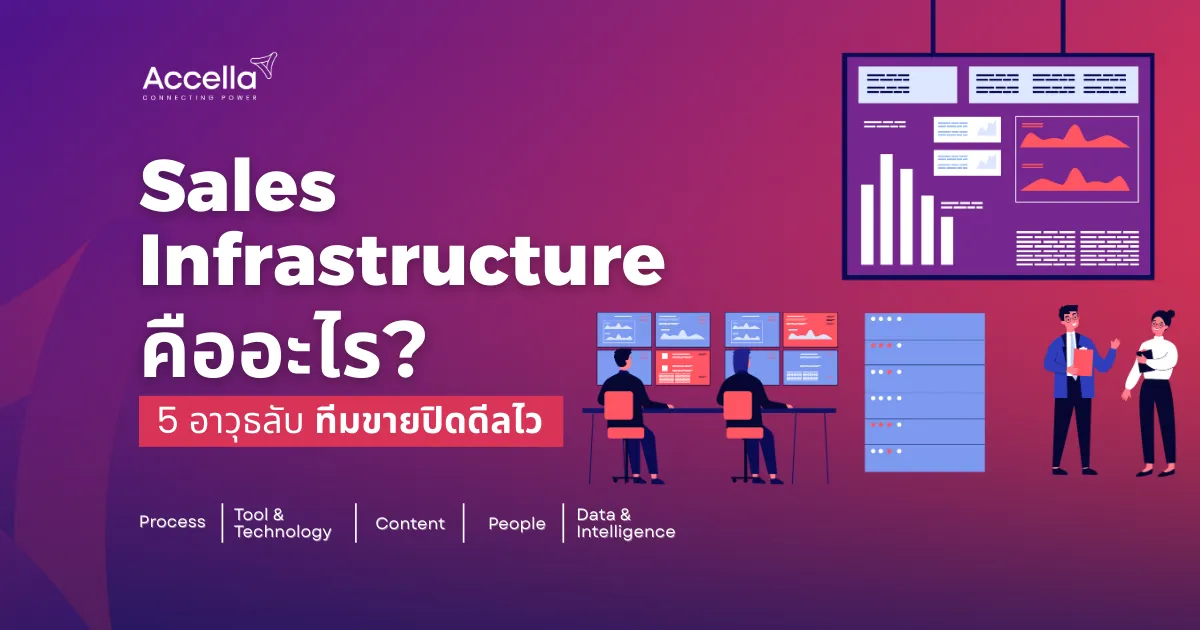
Sales infrastructure is the foundation that lets B2B businesses grow sustainably — a look at the 5 core components (Process, Tool, Content, People, Data) every organization should have in place before chasing more revenue.
In an era where every business runs the same ads, competition is no longer measured by who spends more on advertising. It's measured by who turns an opportunity into a sale more systematically, once that opportunity arrives. A business without solid sales infrastructure loses both the sale and the customer who should have become a repeat buyer — and that loss is entirely avoidable.
What is Sales Infrastructure
Sales Infrastructure isn't just having a sales team. It's a system that strategically connects people, tools, content, data, and process — so that selling happens consistently, measurably, and without depending on whether your best salesperson happens to be at work today.
This is the foundation Accella builds into every system we deliver to clients, whether it's a B2B enterprise with a complex sales cycle or a business aiming for sustainable growth. We believe steady revenue starts with a steady system.
The 5 Core Components of Sales Infrastructure
1. Process — a clear sales process (the most important one)
"You sell well because of the system, not because of one great salesperson."
A business that sells consistently needs a stable workflow — from receiving a lead, to qualifying it, to booking contact, to following up, to closing. Each step needs a measurable "cycle": how many days until a customer must be followed up, what the criteria are for moving from MQL to SQL. It's not contact based on gut feeling — it's execution against a designed system.
B2B organizations need multi-touch follow-up, because decisions take time and involve multiple people. The smaller the team, the more it needs a workflow that lets it operate systematically with fewer hands. A sales-pipeline CRM like Accella CRM helps the team follow that workflow on every deal — from receiving a lead through to close.
2. Tool & Technology — tools that amplify the sales team
"A good system turns an ordinary sales team into a great one."
Good infrastructure needs tools that reduce the burden on people and let the team focus on what actually creates value — a system that unifies every channel (phone / LINE / Facebook / website) in one place, lead scoring, automation that reminds the team to follow up and sends information to customers, and a dashboard that shows revenue and close rates in real time.
This is the role of Accella ONE — the complete automated sales system, which runs everything from front-of-house to back-office work in one system.
3. Content — content that speaks for the brand
"What the sales team says is the company's image."
Whether B2B or B2C, customers judge how "professional" a business is by the conversation. Good content needs a clear opening hook, a set of answers for frequently asked questions, product/service information that's easy to understand, and templates the whole team can use across every channel — so communication quality stays consistent no matter who is talking to the customer.
4. People — salespeople who know their role, inside a good system
"A great person in a bad system burns out. A great person in a good system drives revenue."
Building a sales team isn't just about finding people who are good on the phone. Roles need to be clearly divided (booking / selling / closing / follow-up), there needs to be a framework for communication and problem-solving, and the team needs to practice for real situations. For organizations short on headcount, Accella's Tele Agent phone-sales team can start working on your organization's behalf, on the same system, immediately.
5. Data & Intelligence — data that becomes sales
"A good system has to learn and keep getting sharper."
Every customer response is data that sharpens timing, content, and strategy — analyzing what closes deals, which channel responds best, and feeding those results back into training the team for the next round. Businesses that use data well always improve faster than their competitors. See more at Accella BI — the business database and data intelligence platform.
Conclusion: good infrastructure matters more than a great salesperson
Having one great salesperson doesn't make a business grow sustainably. But having sales infrastructure with all 5 components in place lets everyone on the team "perform" consistently. These five components are why sales should be infrastructure — not a single tool patching one leak at a time.
If your organization is looking to build complete sales infrastructure, talk to our team to design the sales infrastructure that fits your business specifically.