Talk to Accella (LINE OA)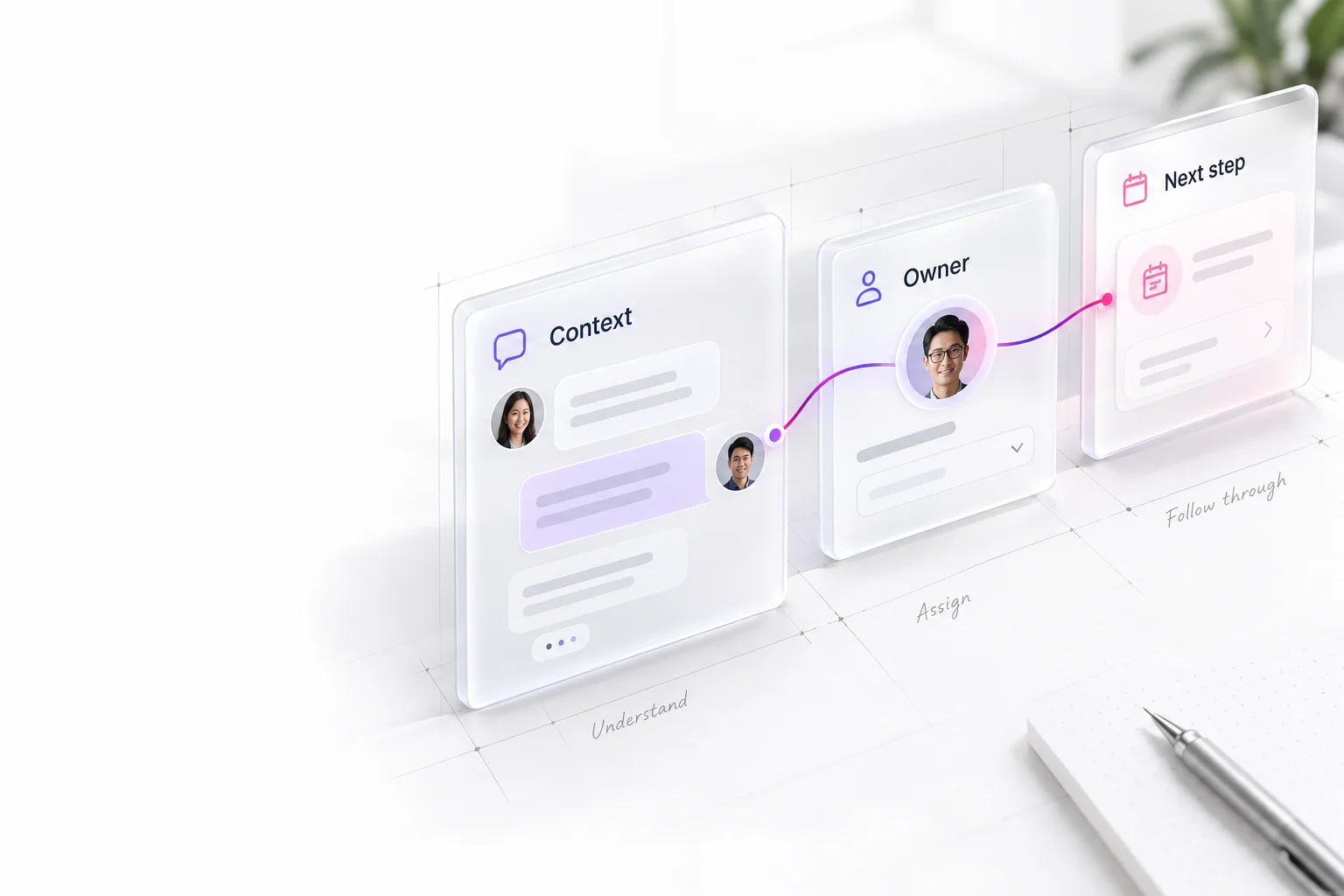
THE BIG PICTURE
Key takeaways
- Lead management covers intake, qualification, follow-up and handover, not just a contact list.
- Statuses need shared meanings and every next action needs an owner.
- Evaluate tools against real handover scenarios.
A customer gets in touch, but the person answering will not be the person following up. If the handover contains only a name and “interested,” the next team has to ask again and may not know what to do or when. Lead management helps close the gap between receiving an opportunity and acting on it.
In B2B, one company may involve several contacts, needs and decision cycles. The system should preserve the context of the business and the work, rather than attach every piece of understanding to a single person.
How does lead management differ from a list or a CRM?
A list tells you who might become a customer. Lead management covers intake, qualification, prioritization, assignment, follow-up and outcomes. A CRM is a tool that may support these processes alongside other relationship activities.
Having a CRM does not mean handover rules are clear. Teams still need to agree on statuses, owners and required information. A spreadsheet may be sufficient for a small operation; reassess when several people must update records simultaneously or trace changes.
What information helps a team take over?
Design the information around the next person's questions:
- Company and stakeholders: organization, branch, contacts and decision-making roles.
- Needs and constraints: what the customer actually said, separate from the team's assumptions.
- Contact history: the topic, channel, conclusion and new information.
- Next action: the task, owner and agreed or planned follow-up date.
- Access: who should see or edit the information, including contact preferences.
Not every field must be mandatory from the first interaction. What matters is knowing what is missing and how it affects the handover.
A useful status explains who does what next
“Interested” might mean accepting information, agreeing to another conversation or requesting a quotation. If teams interpret it differently, their reports cannot be compared meaningfully.
Define entry and exit conditions and who may change each status. For instance, separate “meeting awaiting confirmation” from “meeting confirmed” when using counts to plan work.
Every status should explain what is pending and who acts next.
In a hypothetical example, a customer requests service information and asks to reconnect next week. The record should identify what to send, who sends it and the follow-up action. Accepting information alone should not move the opportunity into a ready-to-close stage.
Share context with an external team
When an outsourced Teleagent team works with an internal sales team, agree on required information, how the receiving team acknowledges work and how it sends a case back for clarification.
Accella CRM (Thai service page) helps Teleagent and client teams share context, history and work. Visibility should reflect responsibilities and permissions. For outreach and customer care support, see Teleagent services (Thai page).
For online enquiries, Accella ONE (Thai service page) connects intake to back-office work within the agreed scope. Data transfers between systems need capability checks and shared rules before use.
Evaluate a system through real scenarios
Ask the team to walk through common situations:
- A previous customer returns. Can the team find the relevant history?
- The owner changes. Can the new person see agreements and pending work?
- The customer is not ready. Can the team schedule follow-up with a reason?
- Information is missing or conflicting. Can it be returned for review with an accountable owner?
- Can reports distinguish businesses, contacts and activities without mixing their counts?
These tests identify process decisions, configuration needs and possible integrations.
Measure continuity before concluding outcomes
Start with unowned work, overdue items, returned handovers and completeness against agreed criteria. Then track opportunities and sales with clear counting units and periods.
Software does not automatically improve close rates. Outcomes also depend on targeting, the offer and execution. The purpose is to help teams spot issues and adapt using information they can inspect.
Lead management is part of sales infrastructure, connecting people, systems and data. Explore Accella's service overview (Thai page) to consider where your business needs a stronger foundation.